
War of the Sea
What is the first thought that pops into your mind when you think of naval warfare? Pirates in the Caribbean Sea? The gargantuan warships of the two World Wars? Vikings? The fact is that naval warfare has been prevalent ever since the dawn of civilization. The greatest calamity of the ancient times, the Bronze Age Collapse, was largely because the prosperous kingdoms of the time such as the Mycenaean Greeks, the Hittites and the Egyptians were unable to deal with naval attacks and raids from the sea, leading to their ultimate demise at the hands of the Sea Peoples.
It would be much later, however, that naval warfare would enter the global arena. It would begin with the Age of Discovery, ignited by the rivalry of the two greatest maritime powers of that era – the Dutch and the Portuguese.

The region of Goa has not been averse from wars of the sea in the distant past. We have viragals or hero stones that depict the Kadamba’s siege of Govapuri, which belonged to the Shilaharas. Likewise, we are told that the Kadambas could raise a fleet of thousands of ships at any time.
At a later point, the Bahmanis and the Vijayanagaras, in their timeless rivalry, fought several naval battles for dominance over Goa. And it would eventually be from the sea itself that Goa would be conquered by the Portuguese. Considering this, it is no surprise that Goa’s impending doom would arrive from the sea as well.
The Glory of Goa Dourada
Goa Dourada, or Golden Goa was a term used to describe Goa during the 16th century. The Portuguese were the first to dominate the trade routes of the Indian Ocean; from the Cape of Good Hope to Mozambique to the Persian Gulf all the way along the coastline of India to the Malay archipelago and onwards to Japan and China, which, unsurprisingly, made it immensely rich.

As Goa was its capital in the East, it would also rise to prominence during this time. It was often known as the Roma do Oriente, or Rome of the East. “Quem vio Goa excusa de ver Lisboa” i.e. “Whoever has seen Goa need not see Lisboa” was a common phrase, which illustrates the grandeur that the city had amassed.
“The houses were painted red or white both outside and inside; they had large staircases and beautiful windows furnished with jetties (sacadas). Instead of glass panes, the windows had thin polished oyster-shells fitted into wooden frame-work.”
Linschoten, Histoire de la Navigation
The Dutch and the Portuguese
Portugal’s monopoly over the trade routes would not go unnoticed by those European powers still on the mainland. The Dutch, in particular, had recently gained their independence from Spain after the Eighty Years’ War. They already dominated trade in the European sphere, being an important distributor of most of the goods brought by the Portuguese.

Following Portugal’s defeat to Spain during the War of Succession and the subsequent formation of the Iberian Union, the Dutch were cut off from all international trade. This would motivate them to establish their own overseas Empire built primarily on commerce. It was this sentiment that gave birth to the commercial behemoths that would come to dominate the world, beginning with the Vereenigde Oostindische Compagnie (VOC) or the United Dutch East India Company, the single wealthiest company in the entirety of human history.
The First Blockade: The Lessons
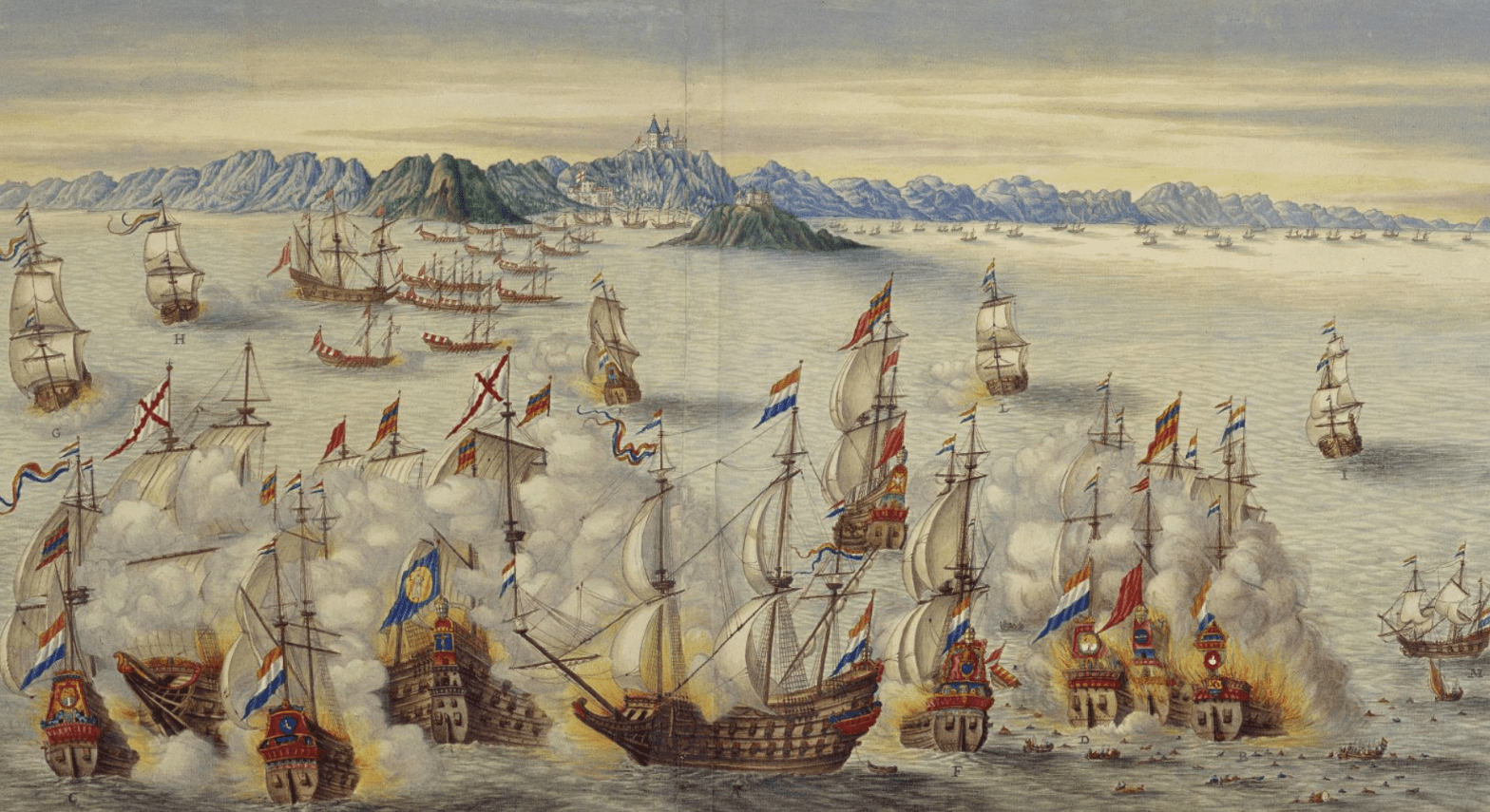
The Blockade of Goa was not an isolated event. Instead, it took place over the span of nearly 60 years, involving two devastating naval conflicts. It would begin in 1604, when the unassuming Dutch surprised the Portuguese by blockading the Mandovi for an entire month, and for two months in 1606. At the time, the Portuguese possessed only two fortresses to protect the mouth of the Mandovi – Reis Magos and Gaspar Dias, but they quickly realized that they had fatal blind spots. This prompted the construction of the Aguada Fort, which was completed in 1612.

The Dutch also learnt a valuable lesson from this encounter, which was that they had no chance of challenging the Portuguese hegemony in Asia without a permanent supply chain for their blockades. And so, they acquired rights from the Bijapur Sultanate to set up their first factory at Vengurla.
The Battle of Goa: The Victories
With their supply chain in place, the Dutch returned in 1638 and successfully blockaded Goa for an entire year by anchoring at the Mandovi sand bar. This would lead to the first major war between the two powers, wherein the Portuguese ultimately managed to secure a victory, adopting a drastic policy of burning their own ships to destroy the Dutch ships. However, the Dutch would still secure the strategic victory, in that they successfully prevented a large merchant ship from leaving Goa.

The next year, they carried out a surprise attack on the Mormugão harbour, where they destroyed three galleons – Bom Jesus, São Sebastião and São Boaventura. Skirmishes and piracy would continue in the open seas, until the Dutch returned for the final time in 1657.
The Second Battle of Goa: The Sorrows
The Second Battle of Goa, between the Dutch and the Portuguese, would begin in 1658 during an already dreadful ongoing blockade. Both sides lost thousands of lives, their gargantuan ships crumbling down into the depths of the sea. It would be a decisive battle, not merely because a peace treaty would be signed between the two powers a few years later; no, the reason this event was of significance is because this dealt the final blow to the Portuguese in the East, signaling that it was no longer the untouchable behemoth of the Seas. This mantle had now passed on to the Dutch.
The Tragedy of Goa Dourada
The immense wealth that the Portuguese had acquired through the spice trade had turned them vain, and their technological progress as well as overseas policies could not keep up with the autonomous, free-trade companies of this new era. Throughout this period of the Dutch blockade, a recurring theme would be the stagnancy of the Portuguese, which was at odds with the rapid development of the Dutch. Goa’s eventual demise as the Roma do Oriente was therefore inevitable. The average wealth of a Goan, both the land-owners as well as the common folk, reduced exponentially. This economic downturn gave rise to further social tensions and political mismanagement, and a general feeling of disdain and distrust would seep into the fabric of Goan society.
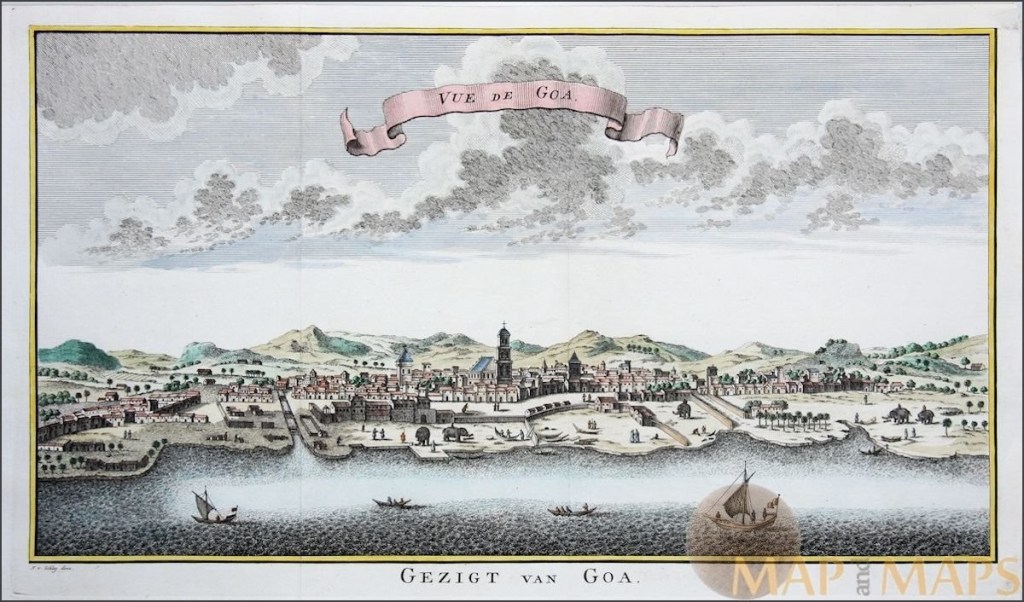
“We see every day in the city houses falling into decay, not on account of the antiquity of the buildings, but for want of money. . . which proceeds from the great poverty and general misery of the inhabitants, most of whom have not even the means of subsistence.”
Senate of Goa
It would not be until 1661 when the Dutch blockade would finally come to an end following the signing of the Treaty of the Hague. But, regrettably, by then the damage had already been done, plunging Goa into the darkest parts of its history, from which it would never truly recover. A relevant poem by Jacob Canter Visscher from his famous “Letters from Malabar” reminds us of this fact, it reads:
“There was a city, glorious and free,
Built on the shore of the dark blue sea,
Where towers and spires of gilded hue,
Shone over the waves of the ocean blue,
And palace and cottage smiling told
How fair was that city in days of old!
But now, from that spot where the glad sun shone,
That glorious city of palms is gone,
Gone with its pride and people so brave,
Whelmed by the tide of the salt sea wave!
Yes! there below the surging deep
Fair Goa’s sunken towers sleep,
All, all that was once glad and bright,
Reposing there in ceaseless night!”
Jacob Canter Visscher, Letters from Malabar
The Golden Goa of the past remains no more, but was it the fault of the Dutch? Or was it the reluctance of the Portuguese to accept the tides of change? We may never know; however one thing is for sure, that the ships of those once mighty Empires that ruled the Seas now rest soundly off the shores of Goa, forever in eternal slumber.
Sources / Further Reading:
- “The Heritage of Govapuri: A Study of the Artifacts In and Around the Pilar Seminary Museum”, Fr. Cosme da Costa
- “An Historical and Archaeological Sketch of the City of Goa”, José Nicolau da Fonseca
- “Dutch attack inspired Aguada Fort”, Paul Fernandes, Times of India
- “Batalhas e Combates da Marinha Portuguesa Vol VI: Bloqueio de Goa 1637”, Saturnino Monteiro
- “Batalhas e Combates da Marinha Portuguesa Vol VI: Bloqueio de Goa 1657”, Saturnino Monteiro
- “Rise and Fall of Vengurla in 17th Century”, Dipesh Karmarkar
- “Treaty of the Hague (1661)”, Military Wikia
 História de Goa

2 thoughts on “The Dutch Blockade of Goa: The Death of Dourada”