
The word fortress is derived from Latin fortis meaning ‘strong’, an adequate name. You might think that the purpose of these fortresses was purely for defending territories or borders, but the more significant reason for constructing such marvels of engineering was to instill fear into enemies, and to deter an attack from ever happening. You see, sieges were expensive, often taking months and sometimes years, with heavy losses on the side of the besiegers if the besieged are prepared.
Some of the most fascinating early fortifications include the nuraghe of the Nuragic Civilization on the island of Sardinia, which are thought to have been used as granaries as well as for ritual purposes, and the oppidum of the Celtic Civilization across Western Europe which served as trading hubs located atop hills.

The style of fortress most familiar to a Goan would be those which house several cannons and prison cells, and whose purpose was primarily to defend against attacks from the sea. However, the most common forts, at least in the medieval era, were those garrisoned with archers and surrounded by moats, deterring attacks at the borders of a kingdom or empire.
The Chandor Fort takes the honor of being the oldest known fortress of this kind built in Goa, most likely constructed by the Kadambas during their Golden Age. Fascinatingly, its legacy lives on to this day in the name of the ward in which its remnants exist – Cotta vaddo, kot being the Sanskrit word for ‘fort’.
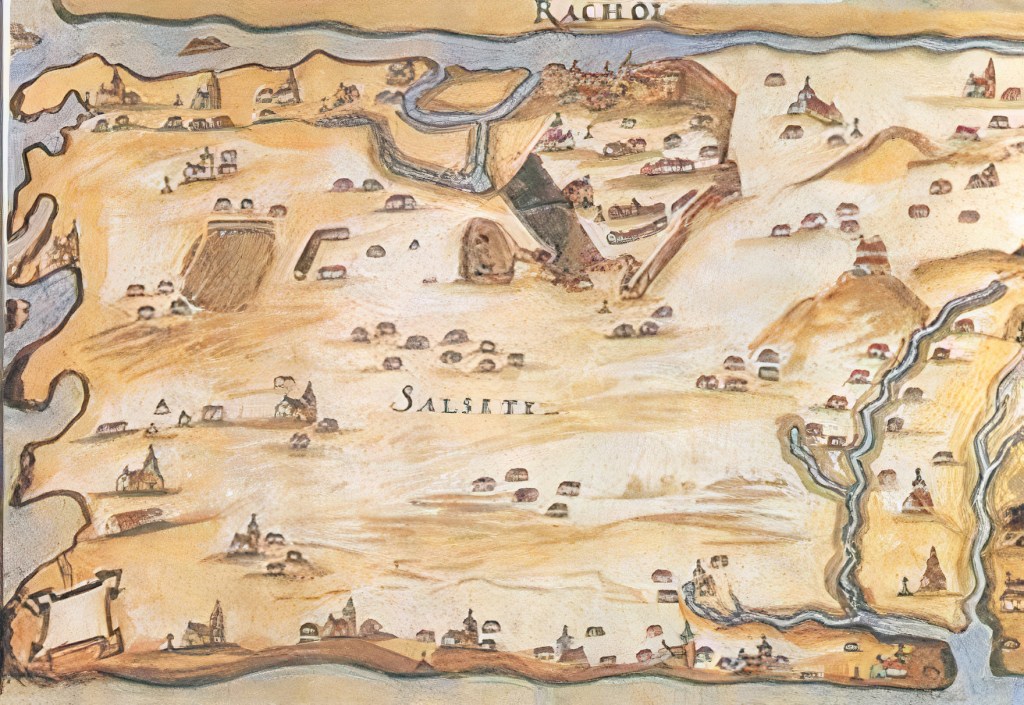
A short distance away in the quaint village of Rachol is yet another fort which most likely rose to prominence after the destruction of Chandor at the hands of Muhammad-bin-Tughlaq of the Delhi Sultanate in 1327. The region constantly shifted hands between the Vijayanagaras, the Bahmanis and later the Bijapur Sultanate, however the fort that existed prior to the Portuguese renovation was said to have been built by a Hindu kingdom. Entering the hands of the Portuguese, this fort would come to be known as the Fortaleza de S. João de Rachol, and would remain the heart of Salcete up until the Novas Conquistas.
The Portuguese Acquisition of Salcete
The Velhas Conquistas, or the Old Conquests, which encompass modern-day Salcete, Mormugao and Bardez, did not enter into Portuguese hands via a single war, rather it involved a series of conflicts between the Portuguese and the Bijapur Sultanate. This began, quite coincidentally, with a war between the Vijayanagara Empire and the Bijapur Sultanate involving a siege of a “Rachol” Fort, so called by Portuguese chroniclers. This was not the Rachol Fort of Goa, but instead the Raichur Fort which lay on the border of the two mighty empires, whose capture had been the source of a timeless war between the two for several centuries stretching back to their inception.

The focus of this article is not so much on this siege, but instead on what occurred in and around Goa during this time. The Portuguese had been eyeing the lands bordering Tiswadi, or Ilhas de Goa, for a long time. The war raging between the two superpowers of South India leaned towards the victory of the Vijayanagaras. And with this, the local Hindu warlords began reclaiming the land around Goa from the Sultanate which had originally belonged to them.

As they approached, a general of the Bijapur Sultanate who owned these lands dreaded losing his territory to the Hindus, and so he struck a deal with the then Captain of Goa – Rui de Melo. He promised to allow the Portuguese to take his lands, in exchange for a percentage of its taxes. In reality, this deal was to ensure that the Hindu warlords would not conquer his lands, as he had very few troops to protect it, whereas the Portuguese had a formidable army. In this way, before the warlords reached the lands bordering Goa, Rui de Melo conquered them in ten days without any bloodshed in the year 1520. This would mark the beginning of the Old Conquests.
The War Against the Sultanate
Of these wars of the Velhas Conquistas, the most interesting and critical was the War for Salcete in 1536, when Nuno da Cunha was the Governor of Portuguese India.
Asad Khan, General of Belgaum and a close friend of Ibrahim Adil Shah, asked Nuno da Cunha to return the borderlands of Goa which were rightfully his. Nuno da Cunha ignored his request, which enraged him. As he was busy with a war already, he sent another general – Suleiman Agha, to conquer the lands for him. Suleiman rode to the Ponda Fort and raised more troops, then marched towards Cacora, and from there onwards to Curtorim and Margao, capturing both. After setting up base at the Margao temple, he moved to capture Verna.
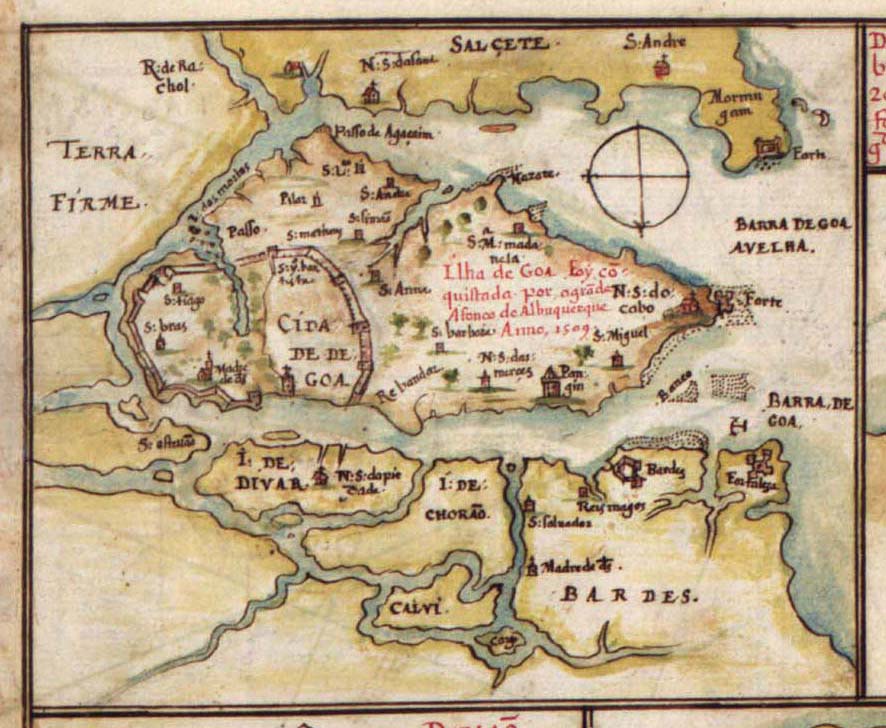
Cristovão de Figueiredo, the Chief of Salcete, was stationed at the Mardol temple at this time. Upon hearing that Suleiman had reached Verna, he immediately sent word to D. João Pereira, the Captain of Goa, asking for reinforcements. D. João sent him a few troops, and Cristovão rerouted them to the Verna temple to protect it. A battle took place at Verna which was indecisive, but the Portuguese were forced to retreat to Mardol, and so the Muslims captured Verna.
D. João tried to negotiate with Suleiman, but his diplomats were imprisoned. In response, D. João declared war and rallied his troops at the Agaçaim Pass. He sent Jordão de Freitas first, whose forces made the Muslims retreat back to Margao. Suleiman realized that soon more reinforcements would arrive, so he decided to make a temporary truce. D. João refused, claiming that Suleiman had illegally entered into Portuguese lands during a time of peace, and that he had one and a half hour to leave. Suleiman left Margao but did not leave the lands of Goa entirely, as he remained garrisoned at Ponda.
The Fortaleza de S. João de Rachol
It was at this point that D. João realized that Salcete was very poorly defended. It had no fortifications like Ilhas and Bardez did, which meant that it would continue to be captured over and over again. To deal with this problem, D. João decided on a place to erect a fort. He found that there already existed the ruins of an ancient fort at a very strategic location off the bank of the Zuari river, at the village of Rachol.

And so, D. João took up the herculean task of revitalizing the fort and making it impregnable within three months. A central Praça, or Square, was built, surrounded by walls of lime. It had 4 bastions around it, with two gates – the Porta do Campo, or Land Gate, which faced Raia and still stands to this day, and the Porta do Mar, or Sea Gate, which faced the Zuari, and has sadly fallen. This Fort, the Fortaleza de S. João de Rachol, would come to be the most important construction in the South, serving as the heart of Salcete for nearly two centuries.
Understandably, Suleiman was terrified of the Rachol Fort. He knew that its completion would spell doom for his plans for conquest, so he employed everything he could to delay its completion. Initially, he sent his troops to Shiroda to construct a wall opposite to the fortress, providing a cover where they could station their cannons. They hindered the construction of the fort and also destroyed boats that came from the capital. D. João was enraged and Suleiman’s Wall was quickly destroyed by cannon strikes.
The Decisive Battle
Several failed attempts later, Suleiman decided that he would destroy the fort himself. He rode to Margao, and sent his underling to Bardez to distract the Portuguese. However, D. João had anticipated this, and sent Jordão de Freitas to defend Bardez, taking the rest of the army with him to defeat Suleiman once and for all.
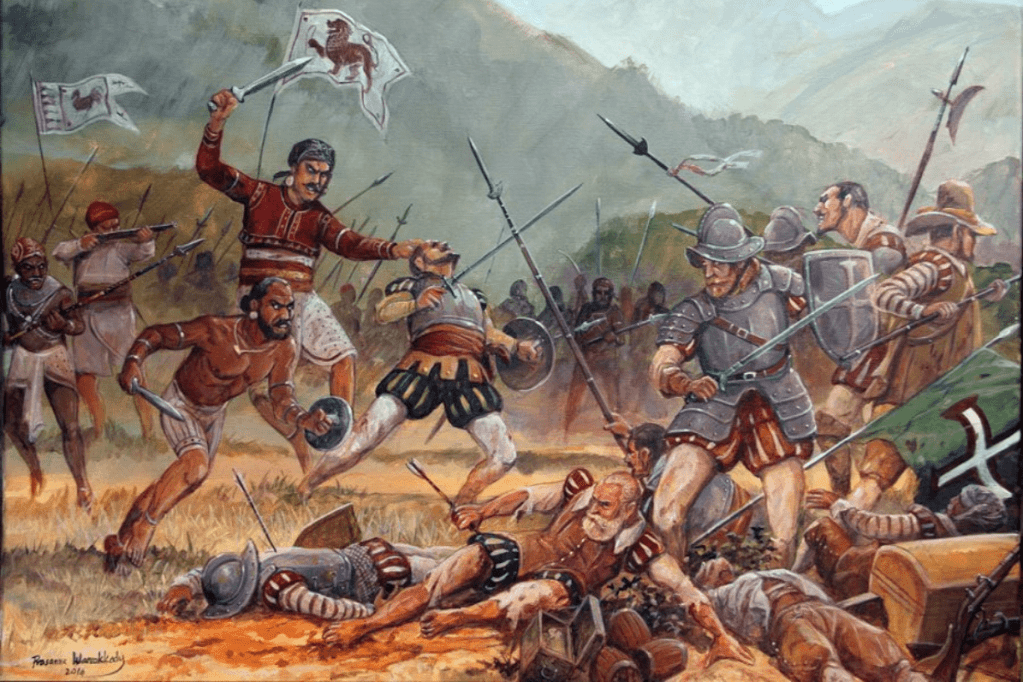
When Suleiman heard of the great force of the Portuguese, he evaded them; but scouts eventually managed to locate him at the bottom of a foothill. The Portuguese rushed there, but were ambushed by the Muslims. The Sultanate used muskets and fire bombs to throw the Portuguese army into disarray; soldiers fled and horses flung their riders off – it was chaos. However, D. João raised morale by leading the charge himself, and the rest of the army followed. The Portuguese overpowered the Sultanate, and many lives were lost that day; but Suleiman managed to escape by the skin of his teeth, retreating to Ponda with heavy losses. This war, the War for Salcete, was fought on the 7th of February 1536.
The Aftermath
This would not be the end, as Asad Khan would soon arrive with a mightier army, and so too would the Governor Nuno da Cunha. A much larger war would ensue between the two, with a clash not just in Salcete, but at other strongholds of the Sultanate as well. Nevertheless, the Fortaleza de Rachol would prove to be central to the protection of Salcete once more, securing the victory for the Portuguese. Peace was made between the two to resume trade, but the wars for control of the Old Conquests would continue for several years ahead.

As you can see, forts were much more than just buildings meant to protect; they did more than just fortify the area they were built in. They struck fear into the hearts and minds of enemies; beckoning for their capture – to gain complete control over the desired land.
The Fortaleza de Rachol may have sadly lost its significance as a beacon of strength safeguarding the borders of the Velhas Conquistas. But despite the centuries that have passed since its birth, the gate through which the knights once rode still stands strong to this day, reminding us of the irreplaceable jewel of Salcete that once adorned the land.
Sources / Further Reading:
- “Décadas da Asia – Terceira Década”, João de Barros (Portuguese)
- “Décadas da Asia – Quarta Década”, João de Barros (Portuguese)
- “A Forgotten Empire: Vijayanagar, a Contribution to the History of India”, Robert Sewell, Fernão Nunes, Domingo Paes
- “Evangelization of the Village of Raia”, Fr. Ivo da Conceição Souza
- “Reconstructing the Urban Maritime History of Goa: A Study of the Port-Capitals of Chandrapur, Gopakapattana and Ella”, Alvita D’Souza
 História de Goa


