

Since ancient times, education was seen as a way to carry forth knowledge and ideas of the past to the future. It began initially through oral tradition, gradually growing more institutionalized as methods of recording information grew more advanced. Religious organizations came to dominate the sphere of education all across the world in ancient as well as medieval times. In fact, it might be surprising to some to know that the oldest university in the English-speaking world which came into being in 1096 AD began as a religious entity and is still in existence to this day – the University of Oxford in England.
Education in Ancient & Medieval India
Likewise, education had a deep-rooted connection to religion in ancient India as well. Besides subjects such as mathematics, astronomy, logic, and grammar, students were expected to study and master the Vedas, Vedangas, Puranas, and Itihasas. The oldest and longest-running university in the Indian subcontinent, the Nalanda University, which was established in the Kingdom of Magadha (present-day Bihar) in the 5th century AD began as a Buddhist monastery but grew to attract scholars and students from all across Asia, including several travelers from China and Korea.

The institution of education was not merely restricted to populous cities and regions close to the heartlands of Hinduism or Buddhism; in fact, numerous such institutions existed all over the Indian subcontinent. In the kingdoms of South India, for example, a fascinating form of ‘residential colleges’ called agraharas grew popular in the early to late medieval era wherein land grants were given to a group of Brahmin priests, who were allowed to autonomously govern these lands and build temples, tanks and whatever else they wished.
These often blossomed into great centers of learning and worship, with pilgrims and students alike coming from afar to study under the wise gurus. Freedom of learning and discussion was given utmost importance, elucidated by the fact that enrollment was completely free of charge, as the donations made by the kings and merchants were enough to keep these communities up and running.
Another institution known as the brahmapuri would be built within or adjacent to an agrahara, whose focus was on an even higher level of education centered around the study of religious texts. A temple would be erected at the center of the brahmapuri, along with a tank and accommodations which served as charity houses for poor and lost vagrants. One such institution, comprising of both an agrahara and a brahmapuri flourished in Goa under the Vijayanagar Empire for several decades, persevering even under the Portuguese rule until the 17th century.
The Provinces of the Vijayanagar Empire

In just a few decades after its inception, the Vijayanagar Empire conquered almost the entirety of South India. Administration of such a vast empire as a single entity would not be a simple task, and so, under its third King – the great King Harihara II, the empire was divided into several provinces or rajyas –
- Konkan (Konkana-rajya)
- North Kanara (Haive-rajya) & South Kanara (Barakur-rajya & Mangaluru-rajya)
- North Andhra (Udayagiri-rajya) & South Andhra (Chandragiri-rajya)
- North Tamil (Padaividu-rajya), South Tamil (Pandiya-rajya) & East Tamil (Muluvai-rajya)
Much later, under the King Krishna Deva Raya, it grew to include Penugonda-rajya (easternmost part of present-day Andhra Pradesh) at its peak.
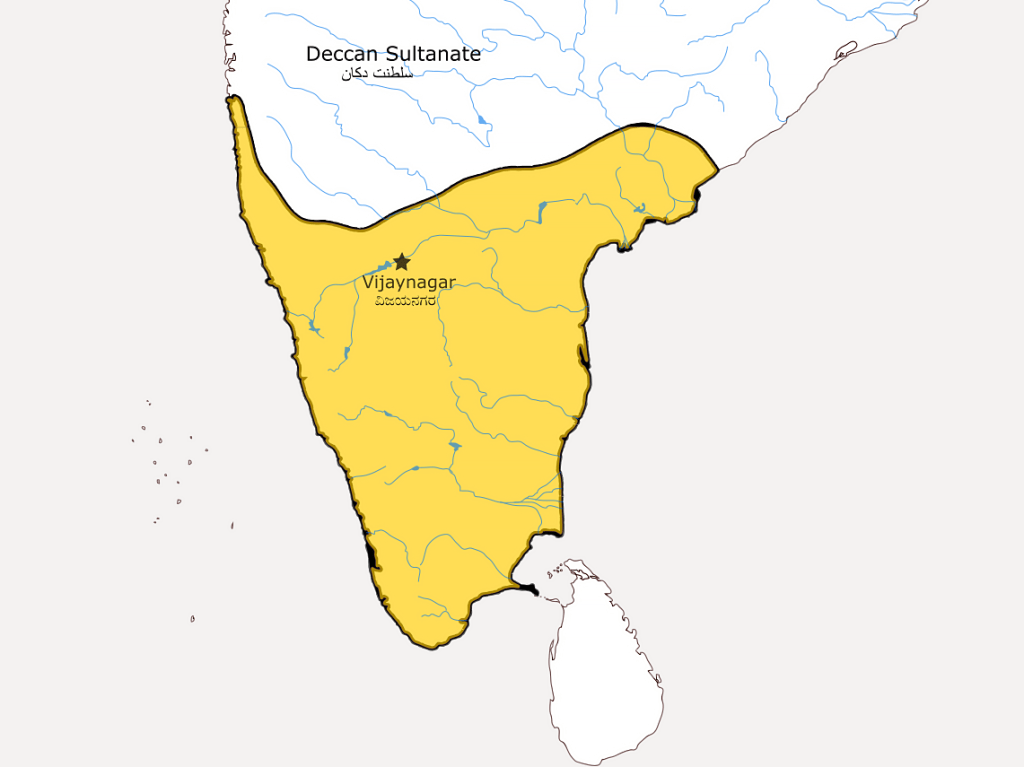
Initially, the administration of the provinces was left largely decentralized, the areas conquered were allowed to rule as feudatories under local warlords. However as time went on, radiating outwards from their grand capital city of Vijayanagar (known today as Hampi), the slow march of centralization took place in order to solidify control over their subjects.
The Battle of Madiyagombu, or The Conquest of Goa

For this purpose, soon after Goa was conquered from the Bahmani Sultanate by the order of Harihara II on 29th August 1380; the man who led the conquest – Mallappa Vodeyar i.e. Vira Vasanta Madhava – was granted the status of mahapradhan of the Konkana-rajya, whose capital was Govapura or Goa. He also served as the governor of Barakur-rajya and Haive-rajya simultaneously at this time, showcasing his status as an important figure in the court of Harihara II who granted him rule over the entirety of the Konkan-Kanara coastline.
“the great minister, a terror to hostile kings, champion over the three kings, destroyer of the Turushka (muslim) army, reducer of the seven Konkanas to dust, plunderer of the Kadamba, protector of the people of Kadamba-pura, boon lord of Govapura, Vira Vasanta Madhava Raya”
– Epigraphs referring to the titles and honorifics of Mallappa Vodeyar i.e. Madhav Mantri
He ruled the Konkana-rajya for ten years until 1390, after which power was handed over to one of his mantris – a Brahmin called Narihari. However, in 1396, Madhav Mantri’s son Bachappa Vodeyar was given the throne. Goa was eventually reconquered in 1470 by Khwaja Mahmud Gawan of the Bahmani Sultanate, after which it fell into the hands of the Adil Shah of Bijapur and eventually the Portuguese.
Madhav Mantri & The Restoration of Goa
Madhav Mantri, as you can see, was held in high regard for not just his military prowess but also for his administrative skill. Mostly known today for his efforts in restoring the Shri Saptakoteshwar Temple and Tank in Naroa, Divar, of which only the Tank now remains (the Temple was reconstructed by Chhatrapati Shivaji across the river in New Naroa or Narve). But what is left unknown is his several other contributions to the prosperity and well-being of Goa.
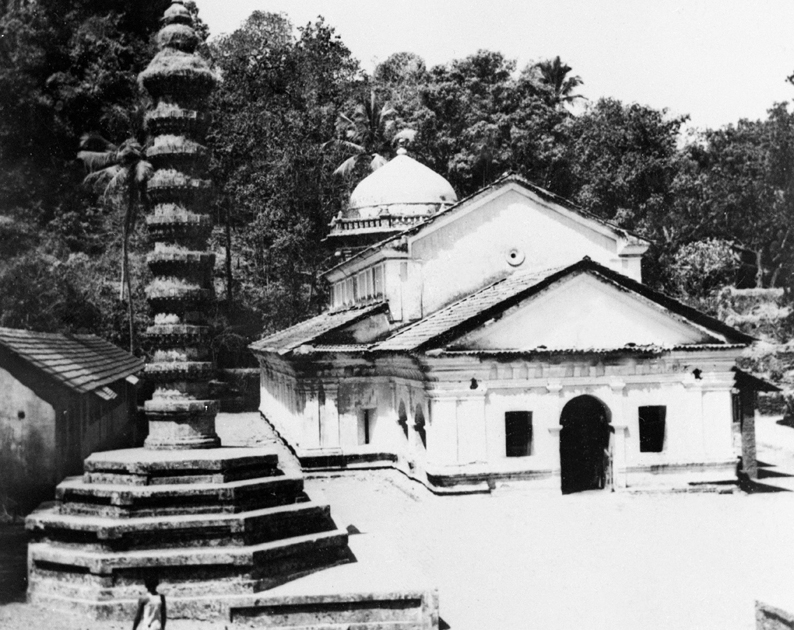
As previously mentioned, an agrahara and brahmapuri existed in Goa under the Vijayanagaras. These institutions grew and survived on the grants and donations given by the rulers of the land, and in this case, the credit goes to Madhav Mantri. In addition to this, he also built the port of Ribandar (Raya Bandhar or Royal Port) on the banks of the river Mandovi, as the siltation of the Siridão and Zuari River had all but destroyed the ports that once flourished along those rivers under the Kadambas.

Lastly, he also oversaw numerous irrigation projects throughout the Konkana-rajya, including the construction of a stone bund across the Talaulim-Moula lake to reduce the salinity of the water used for irrigation. At one point, the Siridão river (known then as the Manchala Samudra) bifurcated into four tributaries, which have now sadly been lost to siltation. Tanks were also built in abundance next to the temples, an important one being the Madhava Tirtha, which sourced its water from nearby springs. It is said that the waters from the Manchala Samudra and the Madhava Tirtha were used to irrigate areca-nut plantations that existed nearby.
Manchalapur: A Center of Learning
Named after his mother Machambika, the agrahara of Machalapur was truly a testament to Madhav Mantri’s desire to restore Goa as not just an important port and capital, but also as a center of culture and learning.

The borders of this Brahmanical village were perfectly delineated in the Bandora copper plate grant made by Madhav Mantri to a group of twelve Brahmin priests from all over Konkana-rajya in the year 1391 AD. It was bordered on the west by the Manchala Samudra, today the Siridão River and Talaulim-Moula Lake; on the east by the main road, most likely the prominent Rajvithi built by the Kadambas; in the south by the Govali plateau; and the north by a tributary of the Siridão River that once flowed. The twelve Brahmin priests were said to have been well-versed in the Rigvedas, hailing from Olaulim, Malar, Verem in Bardez; Candola, Quela, Priol in Ponda or Antruz; and Cuelim – all the way to Chandor in Salcete.
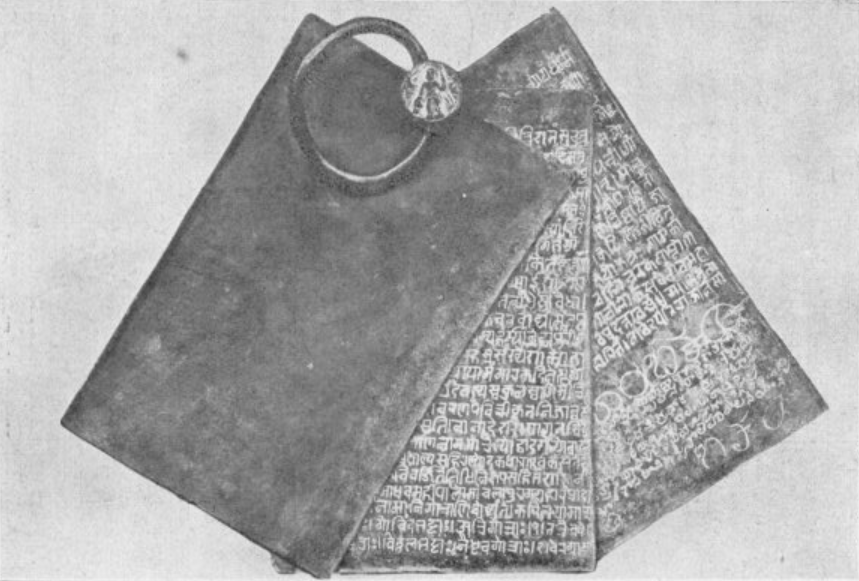
Within the confines of the agrahara, the Brahmins were granted complete autonomy in how they chose to use their funds and in what and how they chose to teach, with the promotion of a culture of unstructured, flexible learning. Students from all over Konkana-rajya and the other provinces of the Empire came to study here as pupils and were allowed to study for free under the priests – as the costs were all paid through grants made by Madhav Mantri and subsequent governors of Goa, as well as rich and influential merchant communities.
Brahmapuri & the Gomanteshwar Temple
Madhav Mantri, along with being a patron of knowledge, was also an ardent worshipper of Shiva, as were the Kadambas. During the Kadamba times, several temples and tanks dedicated to Shiva as Goveshvar (or Gomeshwar) were built all along the Rajvithi. In fact, there likely existed a Gomeshvar Temple in Pilar near where the kuzmorayachem tollem is located today. Another temple was the Gomanteshwar Temple which today lies tucked at the foot of a hill to the west of the Carambolim Lake, within the region of the brahmapuri, northeast of the agrahara of Manchalapur.

The Gomanteshvar Temple, like the Saptakoteshvar Temple, had likely been destroyed by the time Madhav Mantri conquered Goa, and so he took up the mammoth task of rebuilding it, along with the construction of the beautiful tank which came to be known as the Brahmapuri or Madhava Tirtha that received its water from the springs of Manchalapur as well as the sweet waters from the dam or bund constructed over the Manchala Samudra.

Following the conquest of Goa by the Bijapur Sultanate and then the Portuguese, the brahmapuri and consequently the agrahara of Manchalapur were deserted and fell into ruin. Near the site of the brahmapuri was built the Igreja da Santíssima Trindade (Church of the Holy Trinity) in the 16th Century, which was also abandoned and eventually fell into ruin following the devastating plagues that ravaged Old Goa. It is truly a testament to the perseverance of history in the hearts of the common people that despite being abandoned for a long time, people from all over Goa still continued to hold pilgrimages to the Gomanteshwar Temple in remembrance of the brahmapuri.
The Aftermath
In 1775, when the brahmapuri was rediscovered after the plague of Old Goa, it was described as follows:
There exists in Goa near the Holy Trinity Church, which is in ruins, a hidden place very much venerated by the Hindus, built beneath a mountain, and for which to descend there is also a hidden staircase, in the center of which there is a big square tank with a black stone staircase, with the niches of the walls filled with the images of their gods.
– J. M. de Souza Monteiro
Soon after this, due to the Portuguese being afraid of spies from its enemies infiltrating Goa disguised as pilgrims, the ruins were ordered to be buried under stone and lime on 6th June 1779 by the then Viceroy Dom Frederico Guilherme de Souza. Nearly two centuries later, in an ode to the tenacity of history in preserving its greatest works, the brahmapuri was once again rediscovered by the Archaeological Commission in the January of 1933, and rebuilt in 1947 into the structure that we see today.
The temple must have surely looked much grander in the past, with pilgrims from far away lands flocking to study under the gurus that taught there. The agrahara of Manchalapur, the brahmapuri and all of their ruins have now disappeared, buried underneath layers and layers of soil; but if there’s one thing that we can learn from the history of these institutions once central to the identity of Goa, it would be that the culture of preserving knowledge and ideas of our past has never left, even if the structures that embodied them have long since withered to dust.
Sources / Further Reading:
- “Um Passo de Cronista Barros, O Oriente Português N. 18”, Dr. Pandurang Pissurlencar (Portuguese)
- “O Descobrimento dum Santuario Shivaita do Seculo XIV em Velha Goa, O Oriente Português, V. XXX, N. 04”, Dr. Pandurang Pissurlencar (Portuguese)
- “Goa Viragal of the Time of Harihara II of Vijayanagara”, Rev. Fr. Henry Heras
- “Gopakapattana Through the Ages: Ecological and Cultural History of the Island of Tiswadi, Goa”, Dr. Nandkumar Kamat
- “The Flight of Gods, Sri Gomanteshwar Temple”, Mohan Pai
- “The Kadamba Kula: A History of Ancient and Medieval Karnataka”, George M. Moraes
- “Bahmanis and Vijayanagar”, Fr. Cosme da Costa
- “Goa and its Past”
 História de Goa